

Hello, Namaste 🙏 everyone again sciencepandit welcomes you to our blog. Today we are focusing on the term least count and how to use vernier caliper😃. Also, I have added some additional information so that you will get a whole idea of vernier caliper.
Today’s article is mainly for those who are pursuing their studies in 11th or 12th standard or for the scholarship appearing students and diploma as well as engineering students because this is another measuring instrument which is very useful in daily life or you can say for practical purposes also. Many time in scholarship examinations the questions based on LEAST COUNT are asked.
So will first move on to know what is mean by least count?
“It is the smallest reading that an instrument can measure”
It is very important to note that the least count tells you about the precision of an instrument i.e minimum the least count of an instrument more will be the precise readings you will get.
So below you have an image of your normal measuring scale⤵

I know this one is the only measuring instrument which you are using from your primaries 😉 (school). So, we Will calculate the least count of scale and you are already familiar to this instrument so it will help you to remember this forever.
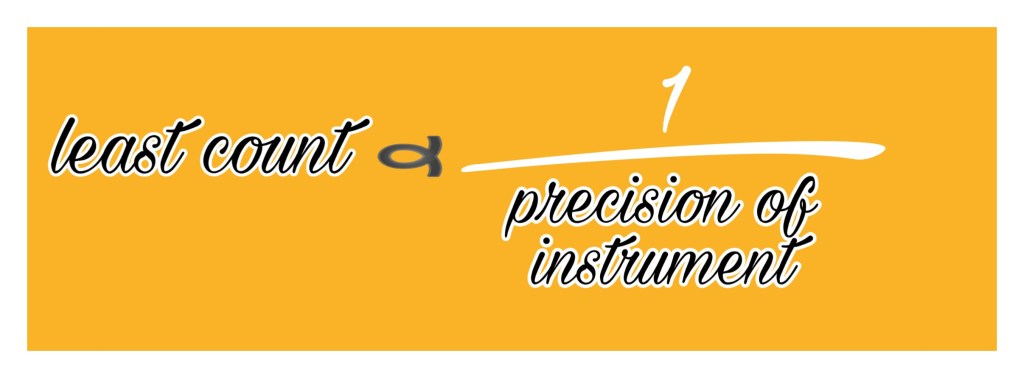
Now the simplest formula for the least count of an instrument is⤵
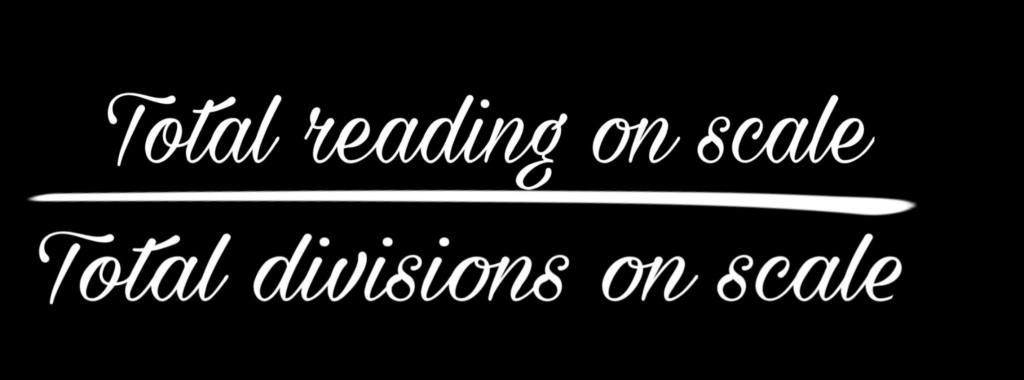
So all you have to get the two things only.
1 ) Total no. Of readings on a scale.
Ex: if the scale is of 15 cm then it’s total no. Of reading is 15 🤓.
2) divisions on your scale.
Ex: if suppose there are 10 lines in 1cm then in 15 cms there are total 15×10 = 150 divisions on your scale.
Like this ⤵
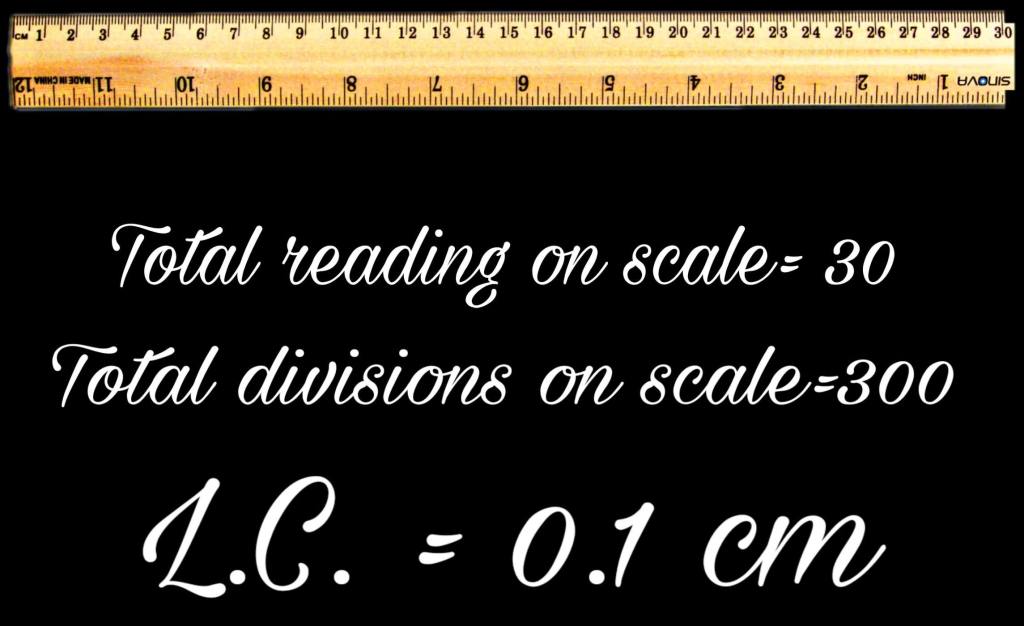
So this 30 cm long scale can measure the minimum distance of 0.1cm or you can say it’s minimum ability to measure the distance is 0.1 cm.
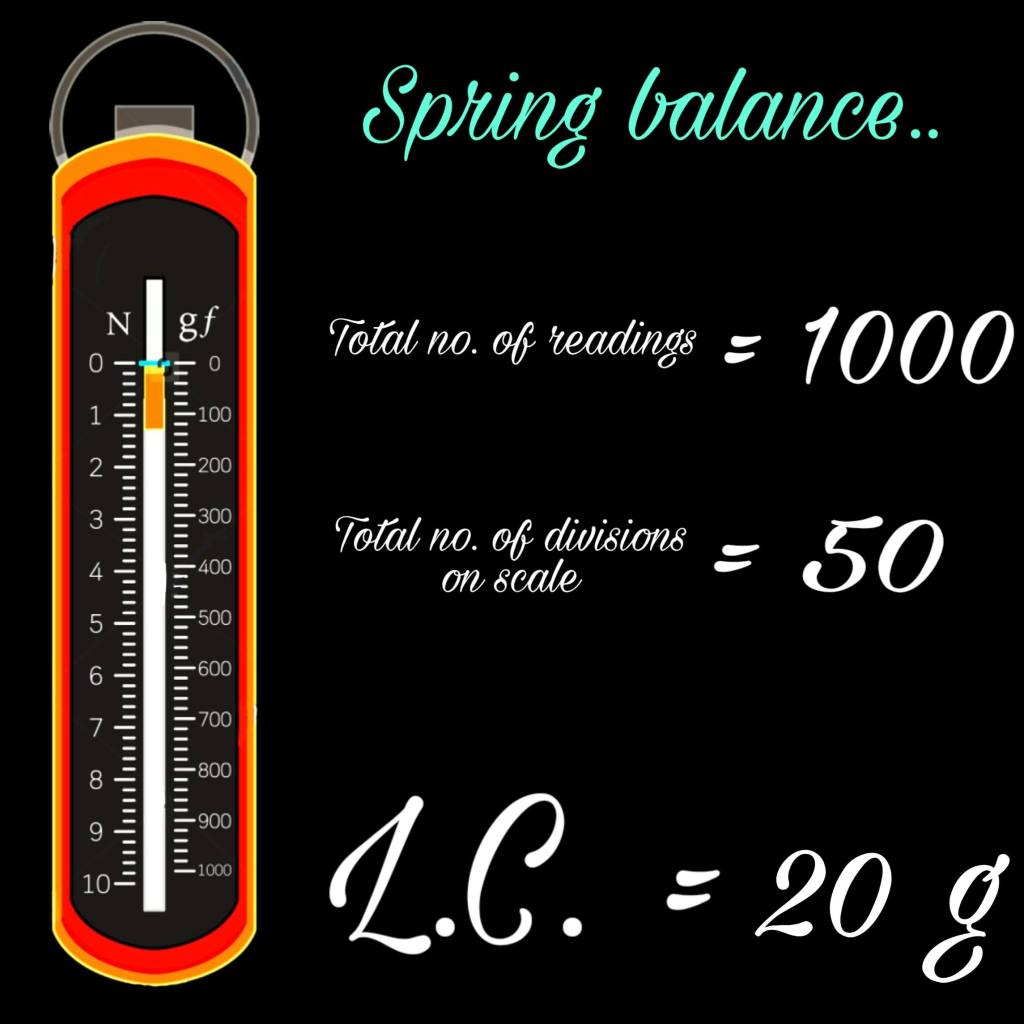
Similarly you can calculate the least count of spring balance🤓
Least count error :
Now the problem ⚠️ is “least count error” which is caused by humans while taking the reading (personal error, etc). It means when you are taking the reading two or three times of the same thing, then you will find that there is a difference in those readings, then mean has to be calculated to minimise the error.
Example:
suppose you are measuring the length of your long glossy hair 😉 and it is observed that it’s one end falls between 50.8cm & 50.9cm. Then an approximation has to be done and which is nothing but the average of these two numbers i.e 50.85cm.
So one can say that the least count of a metre scale will be 0.01 cm😃.
Now, What is vernier calliper? What are the uses of vernier calliper?
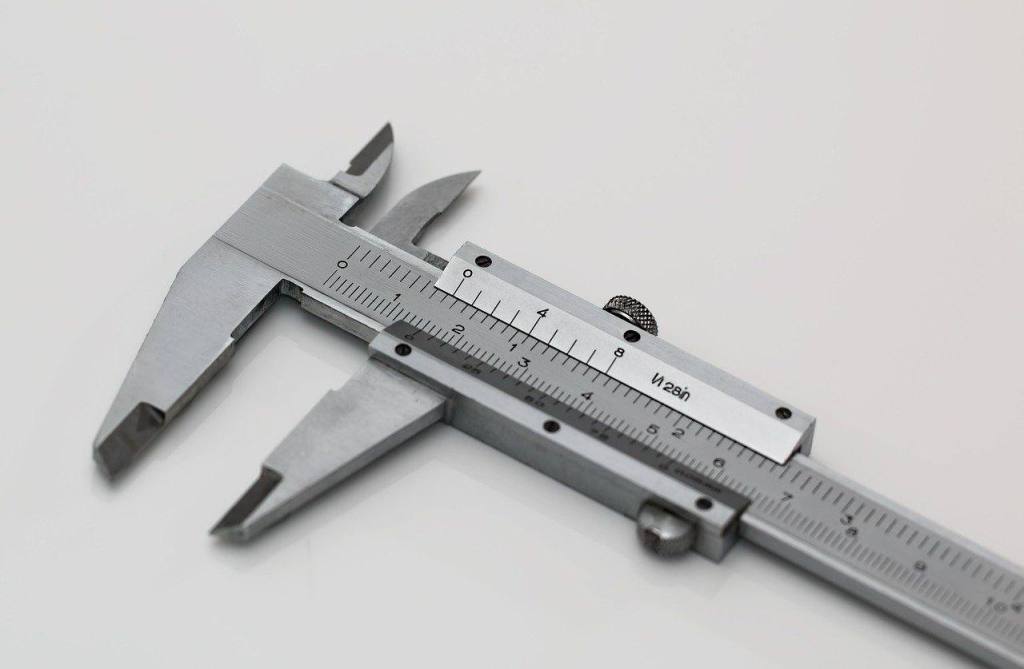
I know those who were already in 11th or 12th science standard and in the engineering field are more familiar 🤓 with this instrument as shown above in the figure.
The reason behind why I’m writing this article about vernier calliper is that when I was in my past years, I had faced many problems in getting this verifier calliper properly and the most troublesome is the term LC (Boleto least count) and how to calculate the least count of verifier calliper and bla bla things of it.
Also, I observed that many of students were trying to mag up the least count of various instruments like verifier calliper, micrometre screw gauge, travelling microscope 🔬 etc.
Even I used to do the same 😝 in my past 12th standard.
Guys before we start into details, I wanna share a real short story of mine which helps me to know the real application of verifier calliper.
This is the year of 2013-14. I lost😔 my Samsung cell phone in the sports campus ( I went there for 100m racing🏃♂️) and then I decided to buy a new cell phone of my own money 💲 and hence went to the industrial sector for the job (1month only).
Now, that was my 1st day in that sector with my friend and I saw such a great man there who is using the VERNIER CALIPER 😃 in a superfast way and my face was like this 😲 And he was measuring the diameter of steel rods.
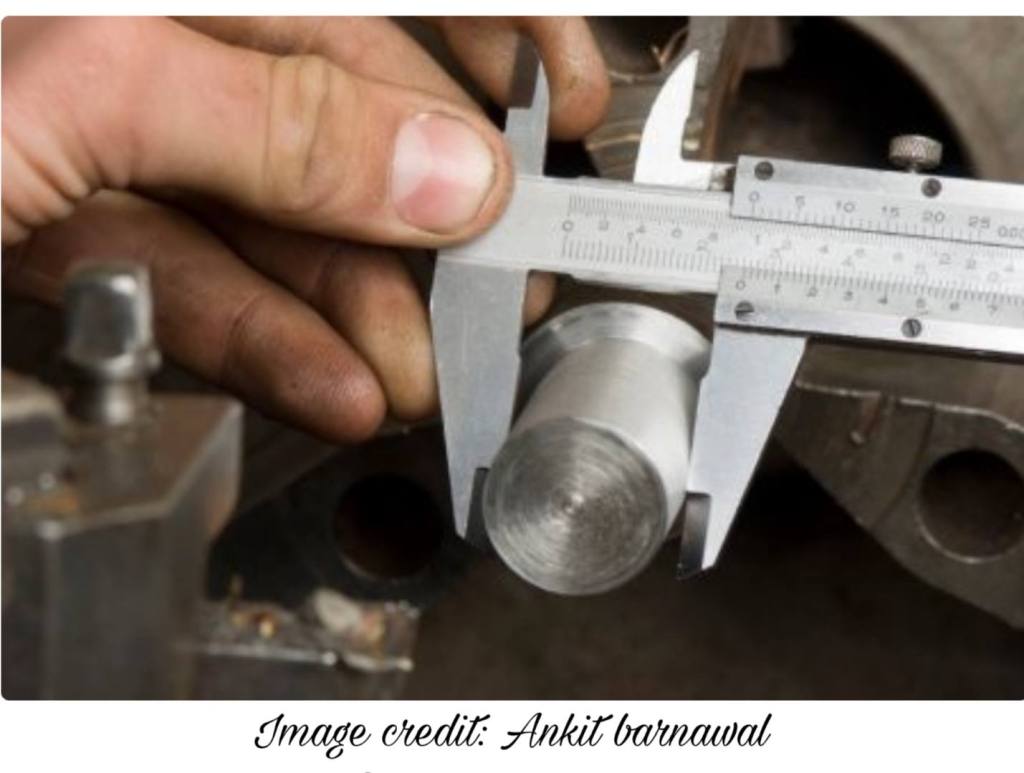
So this is how I realised the real-life application of vernier calliper which is nothing but measuring a diameter of an object.
“”” So the vernier calliper is an instrument which is used to measure the diameter or thickness of an object.”””
So today, I will try to get you to understand this article which will help you in many fields. first of all, we will observe figure of vernier caliper and the various parts of verifier calliper⤵
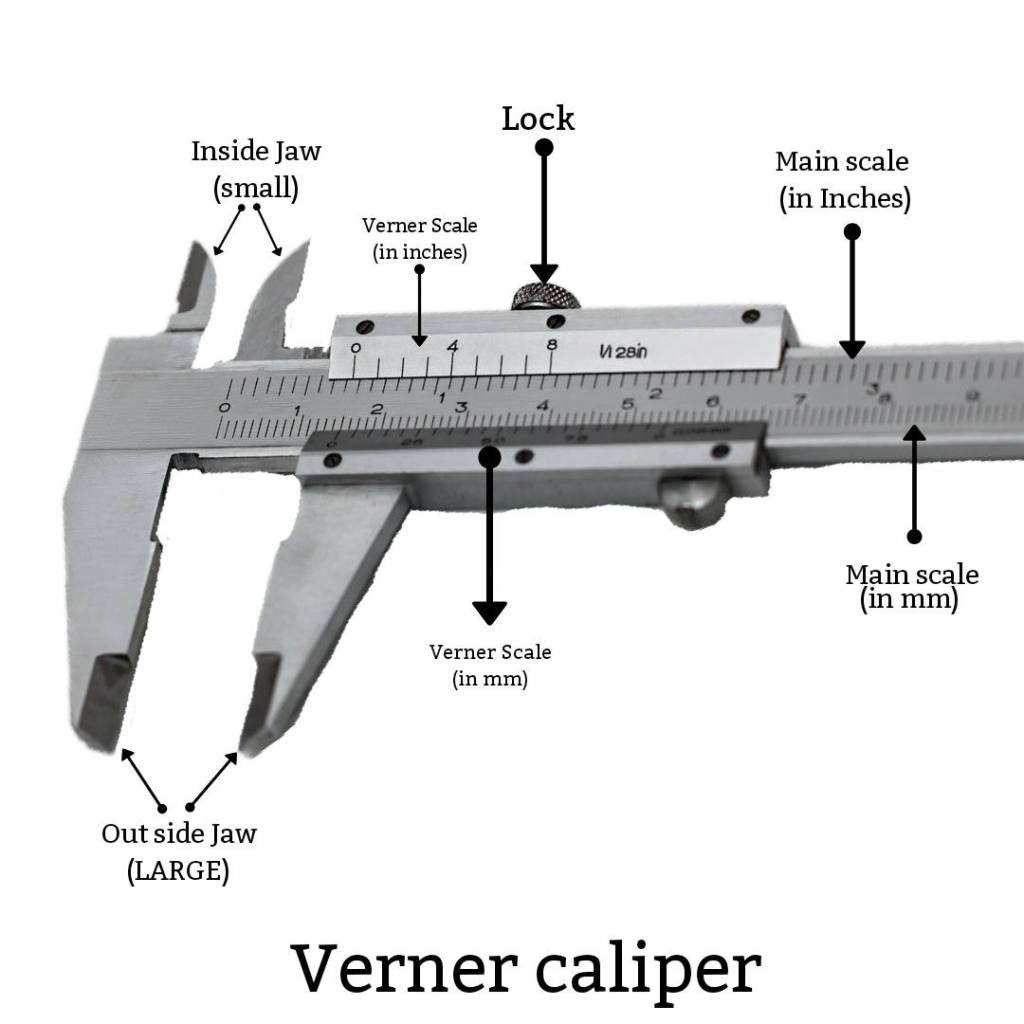
Outside jaw: used to measure the diameter of an object from outside.
Inside jaw: used to measure the diameter of an object from inside.
Verner scale: It slides over the main scale and it has many divisions.
Lock: It is used to fix the verifier scale on the main scale to take the proper reading.
So these are the basic parts or our vernier caliper😊.
Now let’s understand what is mean by “divisions” on an instrument.
Ex. Suppose in a metre scale there are 10 small lines between 1cm then these 10 lines are nothing but the divisions in 1cm only. So for a 15cm long scale, there are 150 divisions in total.

What is vernier caliper least count?
Now, we have the raw material for the recipe called as least count of vernier caliper. The least count of vernier caliper is a little bit different than what we have calculated for our traditional scale.
The vernier caliper least counts formula is:
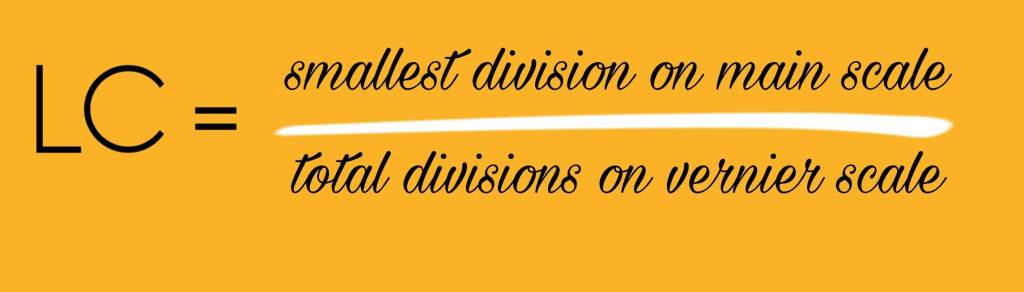
so let’s calculate the least of vernier caliper :
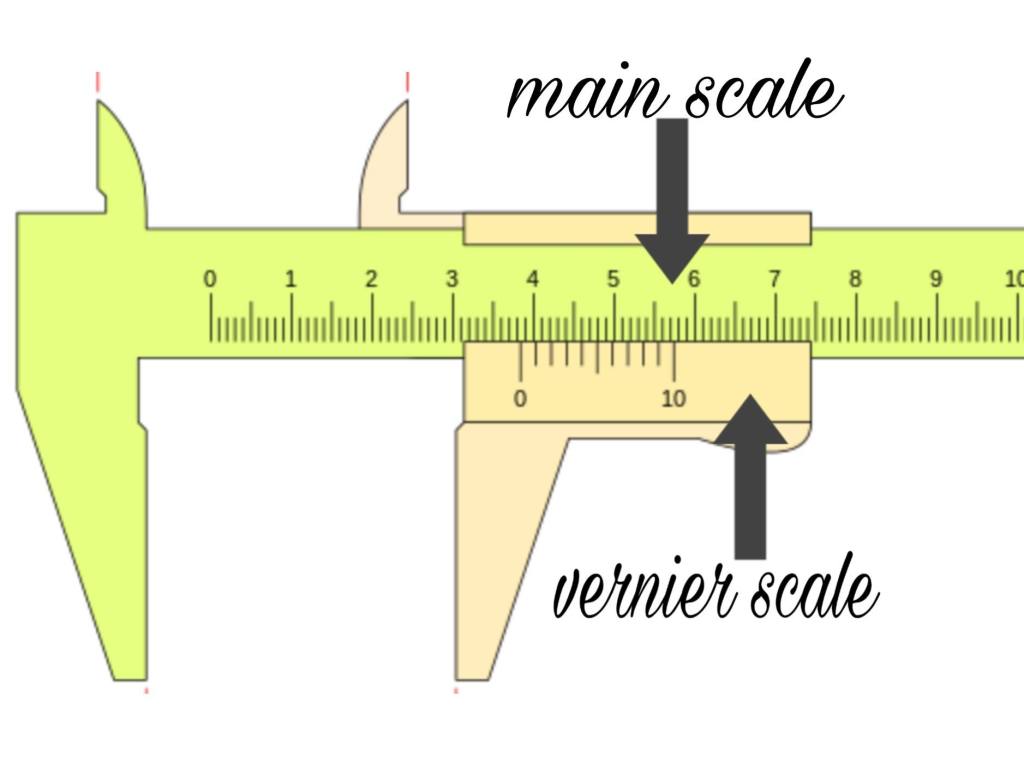
So the smallest division on the main scale is 1mm because there are 10 divisions (lines) In 1cm ( observe the above figure).
While there are 10 lines on a vernier scale so total divisions on the vernier scale are 10.
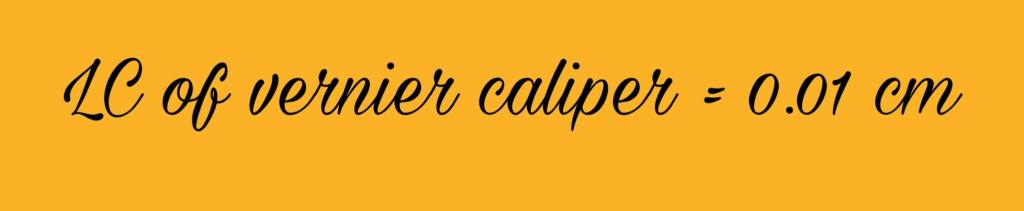
Finally, according to the formula, the least count of vernier caliper will be
= 1mm ÷ 10
= 0.1mm
= 0.01 cm
So least count of vernier caliper is:
ZERO ERROR or vernier caliper error:
Last but not least the “zero error” in vernier reading is again a big factor which is very important to be minimised so that our calculation comes with great precision.
So what is zero error in vernier reading?🤔
“When a zero of main scale reading does not coincide with zero of vernier scale then it is said to have zero error in the vernier caliper”
So you might have thought that why not to buy a new vernier caliper 😝. Again this is not a good idea because how many times you do this each and every time . Having new caliper is not an intelligent idea. So we will now try to minimise this error from the vernier caliper reading.
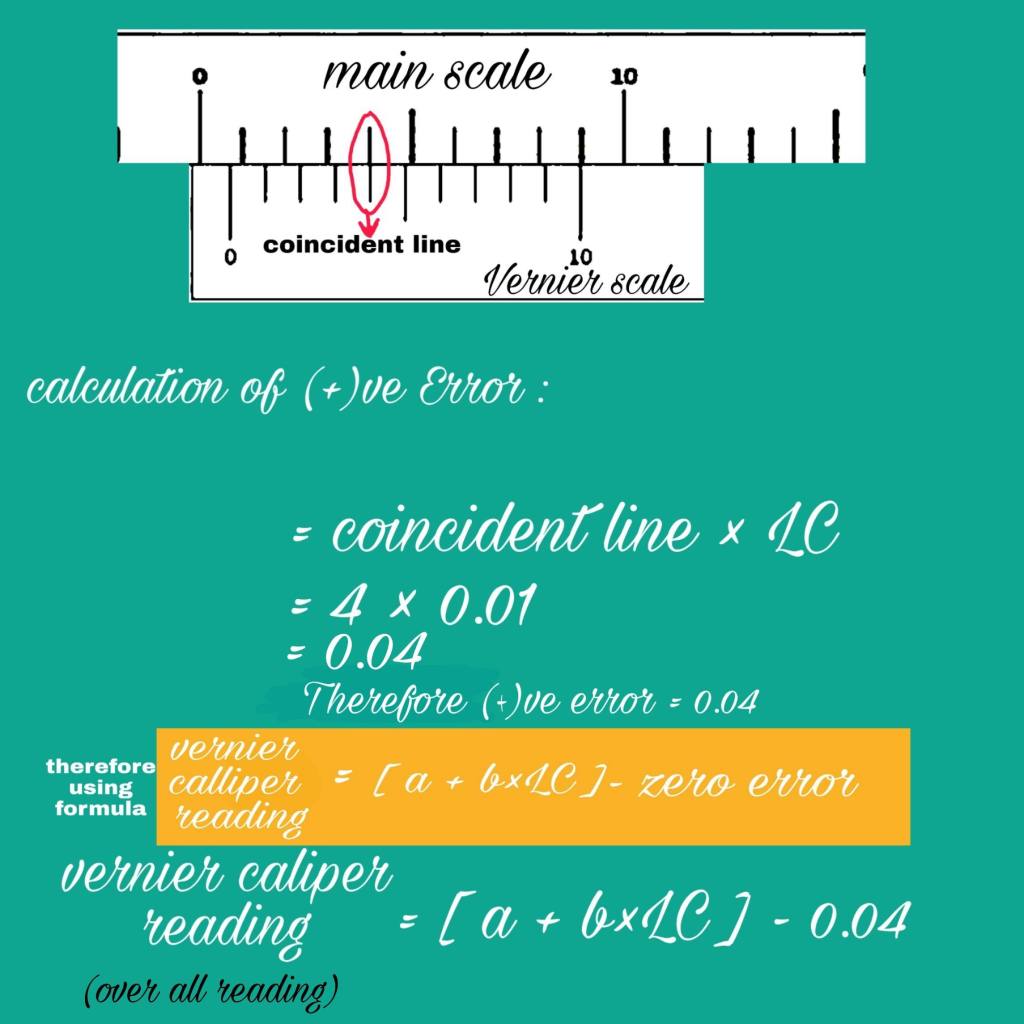
So Will use this formula to calculate actual reading with zero error as⤵

There are two types of vernier caliper error ( zero error )
- Positive error
- Negative error
POSITIVE ERROR:
When you closed the vernier without any object then if the zero of vernier leads the zero of the main scale. ( i.e zero of vernier is on right side of the main scale). Then it is said to be a positive error.😃
NEGATIVE ERROR:
“When zero of the vernier scale lags the zero of the main scale then it is said to have the negative error”

Now we will see how to use a vernier calliper to calculate the length of a screw so that you will understand it better.
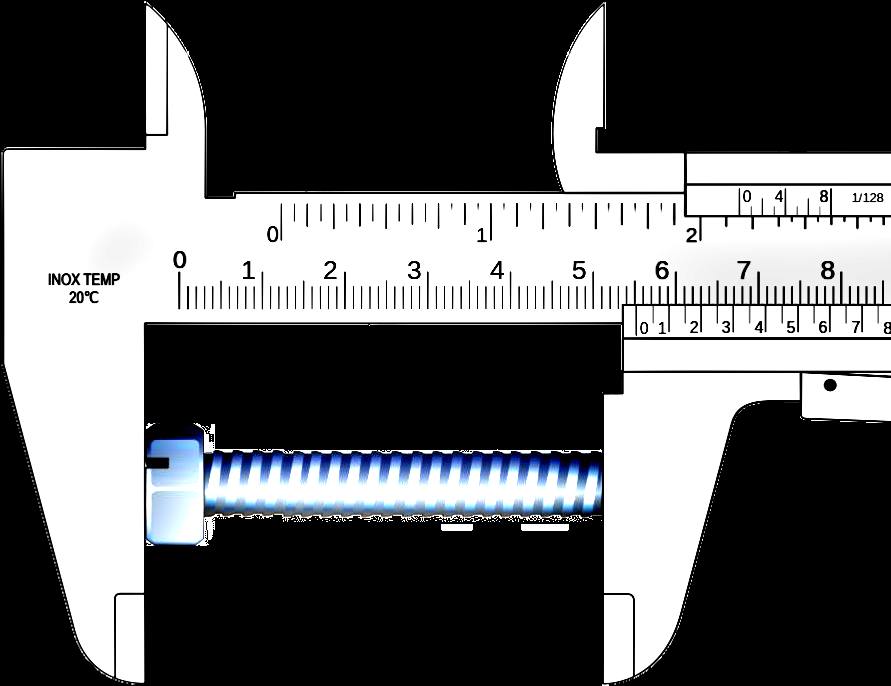
The screw is just in between the jaws of your vernier caliper. The formula which you have already encountered in your past years or say in present is [a + b×LC]😃. So will use this to calculate the length of this screw.
I have put this table below which is your vernier caliper observation table.
| Main scale reading “a” (cm) | vernier or Coincident line “b” (cm) | b×LC | a+(b×LC) |
| —— | —— | —— | —— |
So let’s calculate the values of “a” and “b”
Calculation for “a” :
Form the figure above, if you observe carefully then the zero of vernier scale is just a little bit away from 5.5cm to the right i.e not exactly coincident to 5.5, So “a” = 5.5 cm
Calculation for “b” :
“b” is called a co-incident line so if you observe carefully the vernier scale then the 5th line i.e “2” of vernier is exactly got matched with one of the lines of the main scale. So our “b” is equal to “2” 😃
So finally we have, a=5.5cm b=2
So according to the formula a+(b×LC) will be
= 5.5 + 2× 0.01 = 5.5 + 0.02 = 5.52 cm
So the length of the screw is 5.52 cm ( did you observe this how precise this vernier caliper is!)
Similarly,
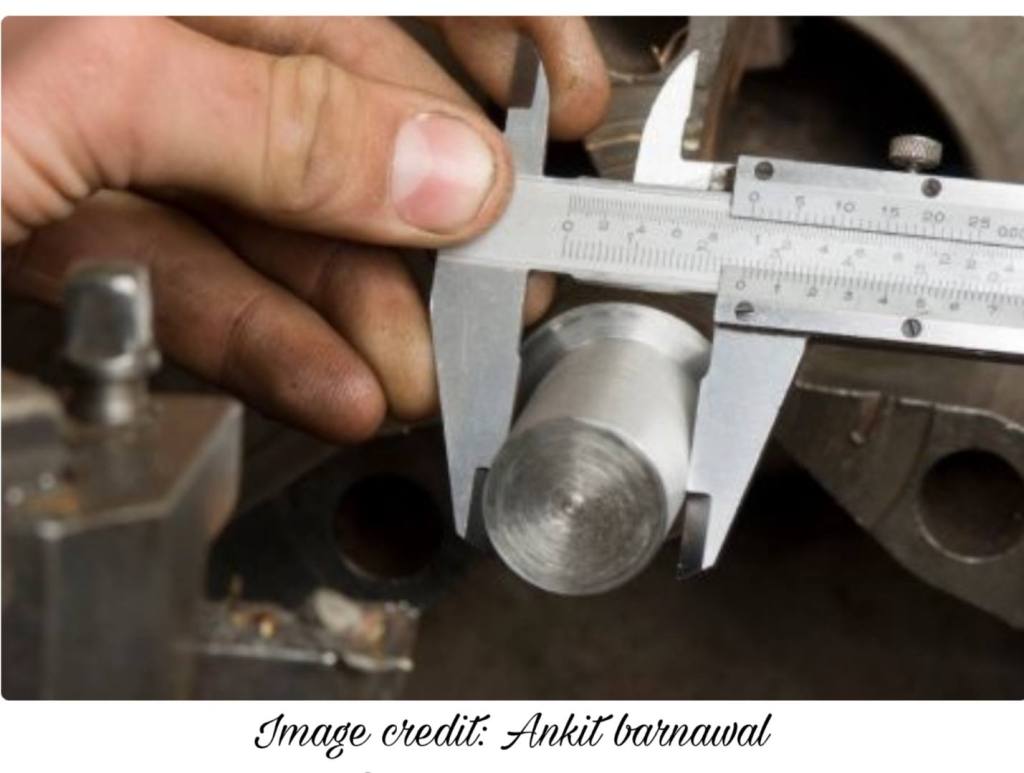
You can have various vernier caliper use. Like You can calculate the diameter of a rod as shown in the figure:
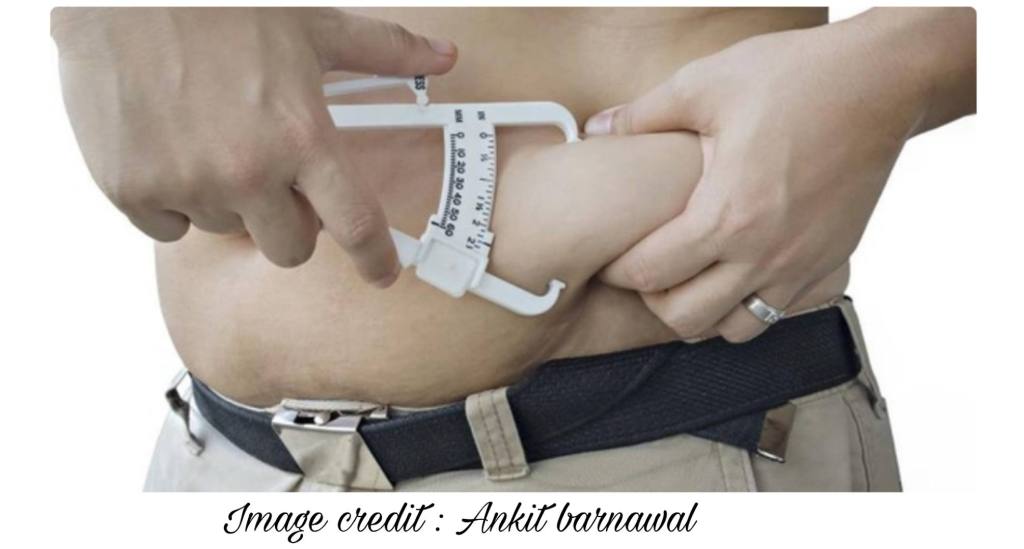
Other application of vernier caliper :
 BASIC PHYSICS AND CONCEPTS..