

Guys WhatsUp, hope all is going beautiful and healthy😊. Today’s article is all about HOW TO CALCULATE THE MASS OF ANY PLANET AND WHY THE MASS OR WEIGHT DIFFERS AT DIFFERENT POSITIONS and guys believe me i’m super excited about this article because when gotten this answer, I feel so amazing and I really think about these crazy scientists that how they get these kinds of crazy ideas to get the mass of any planet by just knowing only two factors😃 that we are going to find out in this article. Now, this is really funny, that when I was in 12th std and when heard about this massive mass of 6000000000000000000000000kg, I used to do like 😲 this (😂🤣🤣😂).My face was worth seeing.

My friend, I don’t know about your bizarre expressions but really this is a very very very😮 huge number and then after knowing this num- ber I just started doing research and research🧐 for the calculation of this massive mass of earth and of different planets as well. Even I searched in many books but I didn’t get the whole steps of calculations, then I started doing some calcula-tions of my own and finally got some answer and guys this value is just like magic for me because it gets the exact match with the standard value😃. I know many of you have heard or calculatede mass of earth by using the formula F=GMm/R^2 but this formula is not applicable for all the planets because we don’t know the force of attraction or the value of “g” of that planet😟
so, let’s go and move on to the journey😃 of knowing the masses of different orbs (planets).
Now, As you know all the planets in our solar system has its own unique natural satellites or even you can say artificial satellite and the moon is our natural satellite of the earth which is revolving around the earth almost in 27.3 days and according to newton’s theory, the centripetal force is the aspect due to which the moon is orbiting our earth. Now we are going to derive the formula from which we are able to find the mass of any planet😃….
we know that necessary centripetal force to the revolving satellite is provided by the gravitational force, so
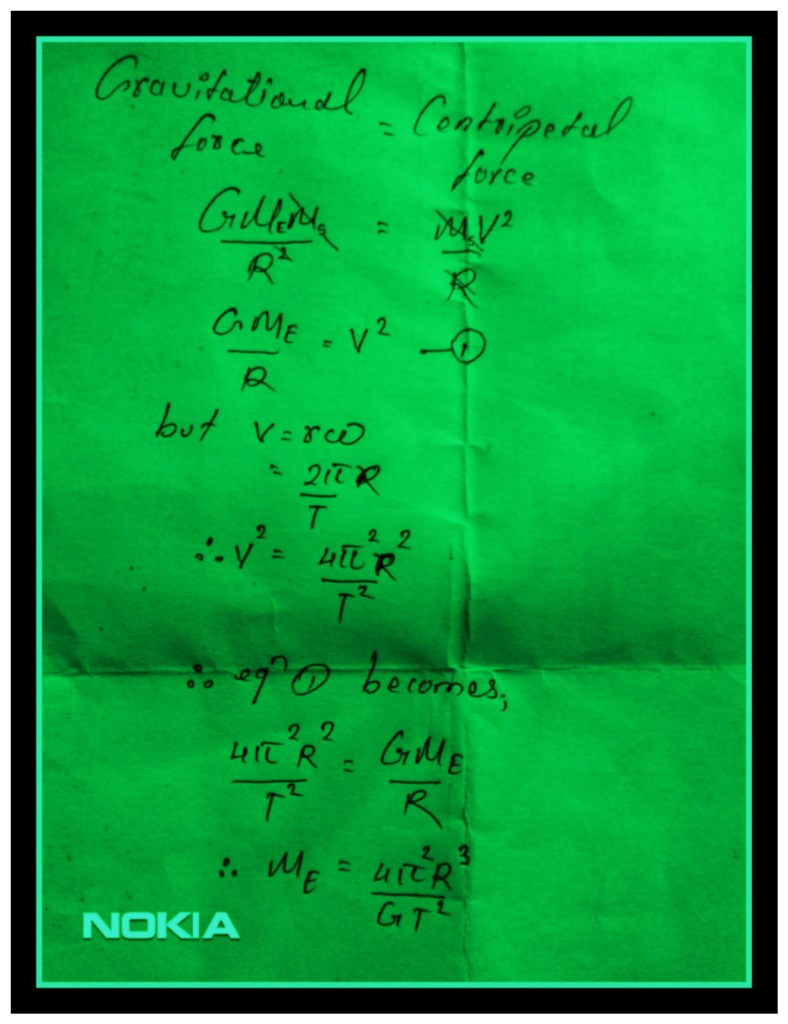
Where,
- M is the mass of any planet
- m is the mass is a satellite
- T is time period
- R is the distance between the planet and its satellite. So with the help of above formula one can the of any planet.
My friend now this above mathematical proof (boleto derivation😭) you have already encountered in the chapter so-called “GRAVITATION” in your SYJC year and definitely you don’t have any idea💡 of the potential of this equation i.e. you can calculate the mass of any planet.
Conclusion:
In order to calculate the mass of any planet one should require with these values;
- The time period of orbiting satellite
- Distance between the planet and its orbiting satellite.
Now in the below table, I have just listed the values of the different time period of satellites and distance between that planet and its satellite so that you can calculate the value of different masses of different planets.
| planets | Satellite | Time-period | Distance |
| Earth | Moon | 27.3 days | 384000 km |
| Mars | Deimos | 1.26days | 23500km |
| Jupiter | Europa | 3.55days | 671000 km |
Now from the above table, I carry out the🤓calculation below for the mass earth🌐
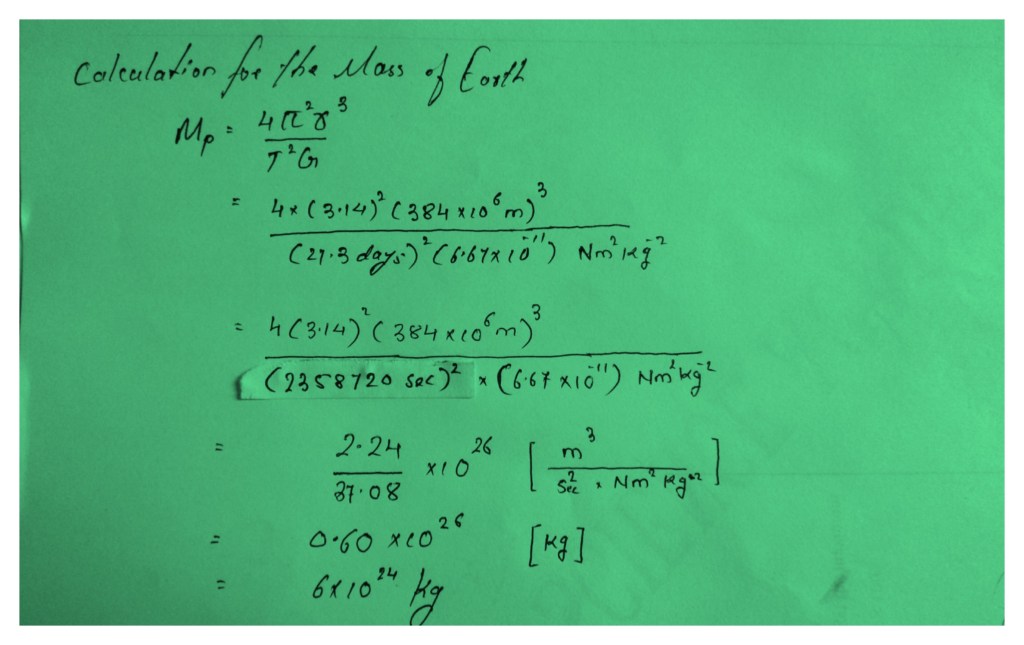
Similarly, with the help of this calculation explained above, you can calculate the values of different masses of different planets.
Now, my friend, can you answer some question,
- How to calculate the mass of the moon? And remember one thing that the moon does not have a satellite so now which method can be used for this.
- Can we use the above method to calculate the mass of the moon?
This problem can be solved by using the formula of acceleration due to gravity “g” which you have already studied in 10th standard and just by putting the value of g of the moon you will get the mass of the moon. Also, u can get the value of the mass of the moon by just using the formula of gravitatio-nal force.
Now, What is the mass and weight of a body on different planets?
Guys now the terms mass and weight were really like a nightmare for me in 10th STD and even today I know most of the students are having wrong ideas about mass and weight or you can say you have a misconception about these both terms. Today I will be discussing the detail information on mass and weight and try to correct your misconception🤗. Now I just want to ask you, my friend, that
- our weighing device gives you the mass? or weight?

if you have this answer with you then let it be with you till the end you will be confirmed at the last🤗.
We will also discuss the below-listed topics :
- What is the unit of mass?
- What is the unit of weight?
- Does mass changes on different planets?
- Does weight changes on different planets?
So let’s move on to the discussion of the questions. So when you weigh yourself as 60kg or bla bla kg on weighing machine it is your mass only not your weight😯 and the SI unit OF MASS IS KILOGRAM (Kg).
Guys just imagine what if the mass of our body changes from place to place 🤣😂 it’s really like a bizarre experience for everyone and what if it changes when you travel from country to another country, so all thanks 😇 to the laws of physics which says that the mass is an independent quantity and remains constant everywhere.
Now why the weight is changing from place to place or from planet to planet 🌛 and the reason is again going to laws of physics 😁 which define the weight I.e the product of mass(m) and the acceleration due to gravity(g)
Boleto, weight=m×g. (SI unit : newton)
So simply you can see that the weight depends upon the values of “g” and when the “g” changes, definitely the weight also changes.
Now,
We will find the different values of weight on different planets and for this, we require the “g” of that particular planet so first, let’s go for the moon.
The “g” of the moon is 1/6 times that of ‘g” of earth I.e.1/6×9.8= 1.63 ( SI unit ).
so if I’m 60kg ( mass)
- On EARTH:
- acceleration due to gravity (g)= 9.8 m/s^2
- My Weight: 60×9.8=588 N
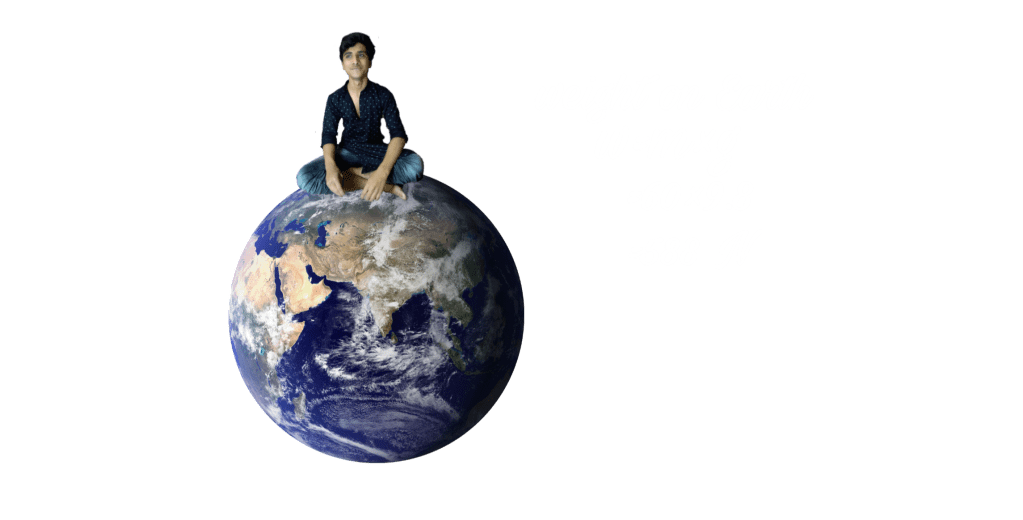
- On MOON:
- acceleration due to gravity =1.63 m/s^2
- My weight: 60×1.63=97.8 N
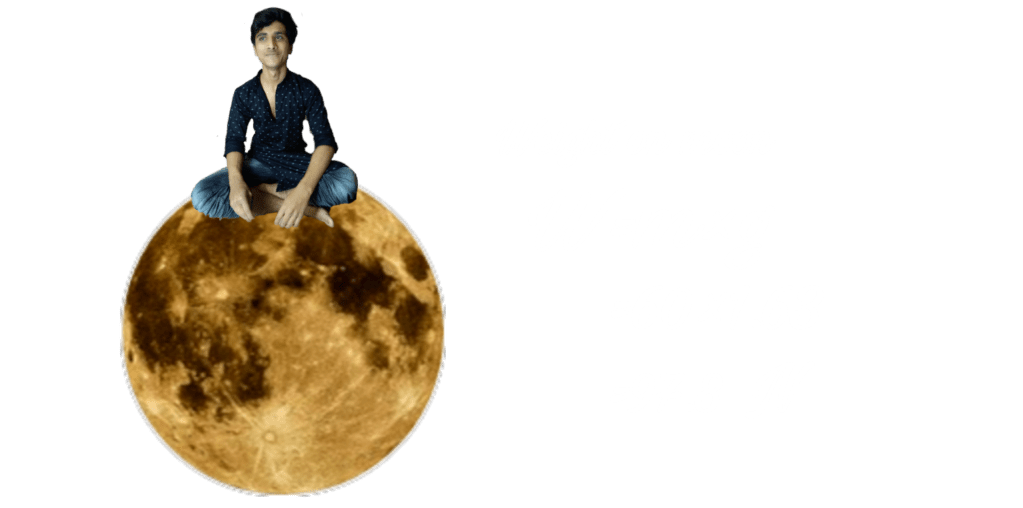
So, you can observe from above the weight on the moon as compared to the earth is so small 🤣
And because of this, it is difficult to walk on the moon and hence the astronaut have to jump on the moon for the walking 👣 purpose🤣😂🤣😂 it’s funny na jumping for walking🤣
Final Conclusions:
- To find the mass of a planet we require two things:
- The time period of its satellite i.e time taken to complete one revolution
- Distance between the satellite is independent quantity i.e it does not change with a place to place.
- Mass is independent quantity I.e it does not changes.
- Weight is dependent quantity i.e it changes from place to place.
- Weight depends upon “g”

 BASIC PHYSICS AND CONCEPTS..